Profound is one of the most capable AI search visibility platforms on the market — its 4.6/5 rating across 845 G2 reviews is not an accident. But capability is not the complaint. The complaints, consistently, are about price, packaging and the fact that after all that measuring, you're still on your own to fix anything. This guide compares five real alternatives, including our own product, with genuine pros and cons for each.
Why people look for Profound alternatives
People look for Profound alternatives because it is priced and packaged for enterprises and stops at reporting: multi-engine tracking effectively starts at $399/month, self-serve plans have no multi-account management for agencies, the dashboard has a real learning curve, and it measures AI visibility without changing what crawlers receive from your site.
Review mining across G2, Capterra and Trustpilot surfaces the same themes repeatedly:
- The real entry price is $399/month. The $99 Starter tier tracks ChatGPT only, with 50 prompts and a single seat. Multi-engine tracking starts on the Growth plan at $399/month (billed yearly), and full engine coverage, larger prompt volumes and API access all require a custom Enterprise quote — which third-party reviews in early 2026 put at roughly $2,000–$5,000+ per month.
- Agencies hit a wall. There is no multi-account management on self-serve plans. If you run several brands, you're negotiating an Enterprise contract or juggling separate subscriptions.
- The learning curve is real. Reviewers praise the analytics depth but describe the dashboard as data-heavy and overwhelming for smaller teams, with friction exporting data for client reports.
- It measures; it doesn't act. Profound tells you how AI systems see your brand. It doesn't change what AI crawlers receive when they visit your site — and its Agent Analytics reports page categories rather than exact URLs, which limits what you can actually do with the findings.
- Trial friction. The free trial is 7 days on Growth only, and some reviewers reported unexpected post-trial charges and difficulty cancelling.
None of this makes Profound a bad product. It makes it a specific product: enterprise-budget monitoring and research. If that's not the shape of your problem, there are better-fitting options.
What to look for in an alternative
Look first at which camp a tool sits in: monitoring tools (Peec, Otterly, Rankscale) track how your brand appears in AI answers and produce reports, while tools that act (Klove, Scrunch AI) change what AI agents actually receive when they crawl your site. Knowing which camp you're shopping in saves a lot of demo calls.
Monitoring tools track how your brand appears in AI answers — prompt tracking, citation analysis, competitor benchmarking. Peec, Otterly and Rankscale live here. They differ on engine coverage, refresh frequency and price, but the output is always the same thing: a report.
Tools that act change what AI agents actually receive when they crawl your site. Klove and Scrunch AI both serve machine-readable, agent-facing pages at the edge. If your pages are JavaScript-heavy or your key information is buried in modals and tabs, monitoring alone will just document the problem in higher resolution.
Beyond that split, the criteria worth weighing — the same ones in the table below — are:
- Agentic pages — can the tool serve optimised versions of your pages to AI crawlers, or only report?
- Prompt monitoring and citation tracking — table stakes, but check refresh frequency (daily vs weekly) and how prompt limits are counted across engines.
- AI crawler analytics — does it track real AI bot visits to your site, or only simulate prompts against LLMs?
- Content optimisation — does it tell you what to change, or just what happened?
- Pricing shape — entry price, what's gated to Enterprise, and whether costs are predictable as you add prompts and engines.
Profound alternatives compared
Klove is our product, so read the row accordingly — but every cell below comes from the same verified dataset we maintain for all six tools, pricing last checked July 2026.
| Tool | Agentic pages | Prompt monitoring | Citation tracking | AI crawler analytics | Content optimisation | Pricing | Free trial or free tier |
|---|---|---|---|---|---|---|---|
| Klove | ✓ | ✓ | ✓ | ✓ | ✓ | From $69/mo | ✓ |
| Scrunch AI | ✓ | ✓ | ✓ | ✓ | ✓ | From $250/mo | ✓ |
| Peec AI | ✗ | ✓ | ✓ | ✓ | ✗ | From $95/mo | ✓ |
| Otterly.AI | ✗ | ✓ | ✓ | — | ✓ | From $29/mo | ✓ |
| Rankscale | ✗ | ✓ | ✓ | ✗ | ✓ | From $20/mo | ✓ |
The five alternatives in detail
Each entry below includes genuine cons — ours included. Ratings are quoted only where a tool has a real, attributable review base.
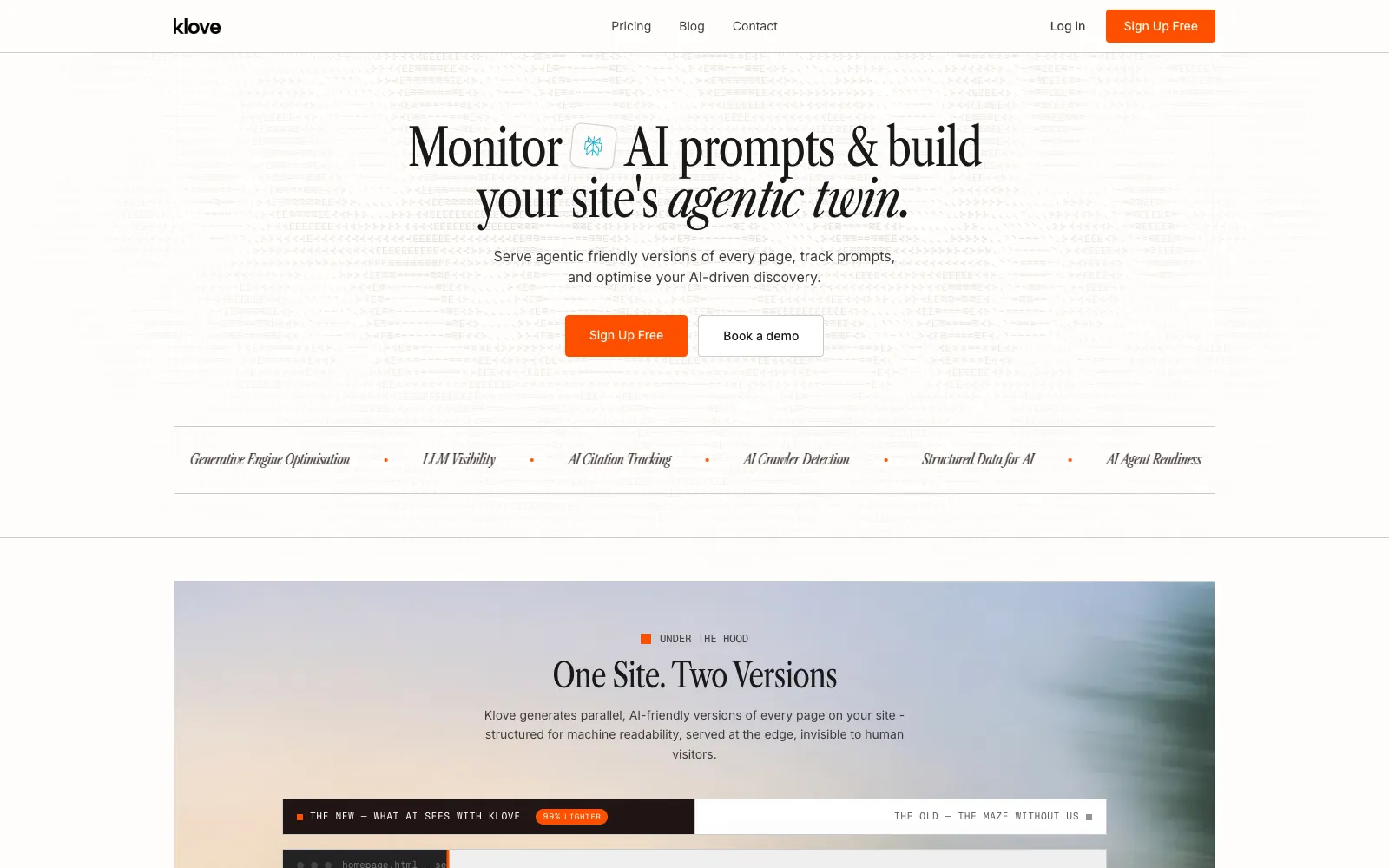
Agent Presence Platform that serves curated, machine-readable agentic pages to AI crawlers at the edge, alongside AI traffic analytics, prompt monitoring and citation tracking.
Pros
- Agentic pages from the entry-level paid tier, not gated behind an enterprise add-on
- Transparent side-by-side editor — you see and control exactly what AI agents receive, rather than a black-box auto-conversion
- Curated and enriched agent pages (FAQ blocks, structured pricing, external reviews from Google, YouTube, Reddit and LinkedIn) instead of mechanical HTML-to-markdown stripping
- A/B testing of agent page variants, including per-platform targeting (e.g. different versions for ChatGPT vs Perplexity)
- Lightweight edge middleware (~200 lines, zero dependencies) with graceful fallback — human visitors and search crawlers always get the original site
- Free AI traffic analytics tier tracking 200+ AI agent signatures, so you can see the problem before paying for the fix
Cons
- Newer product with no published customer case studies or proof-point metrics of its own yet
- Little to no third-party review footprint (no established G2/Capterra presence), so independent validation is thin
- Edge middleware setup is currently a manual copy-paste of a Cloudflare Worker script; one-click deployment is still on the roadmap
- MCP (Model Context Protocol) support is roadmap, not shipped
- Entry tier is tight for larger sites — 3 agentic pages and single-country prompt monitoring on Essentials
- Public API access is not documented, and the go-to-market focus is Australia and the UK rather than global
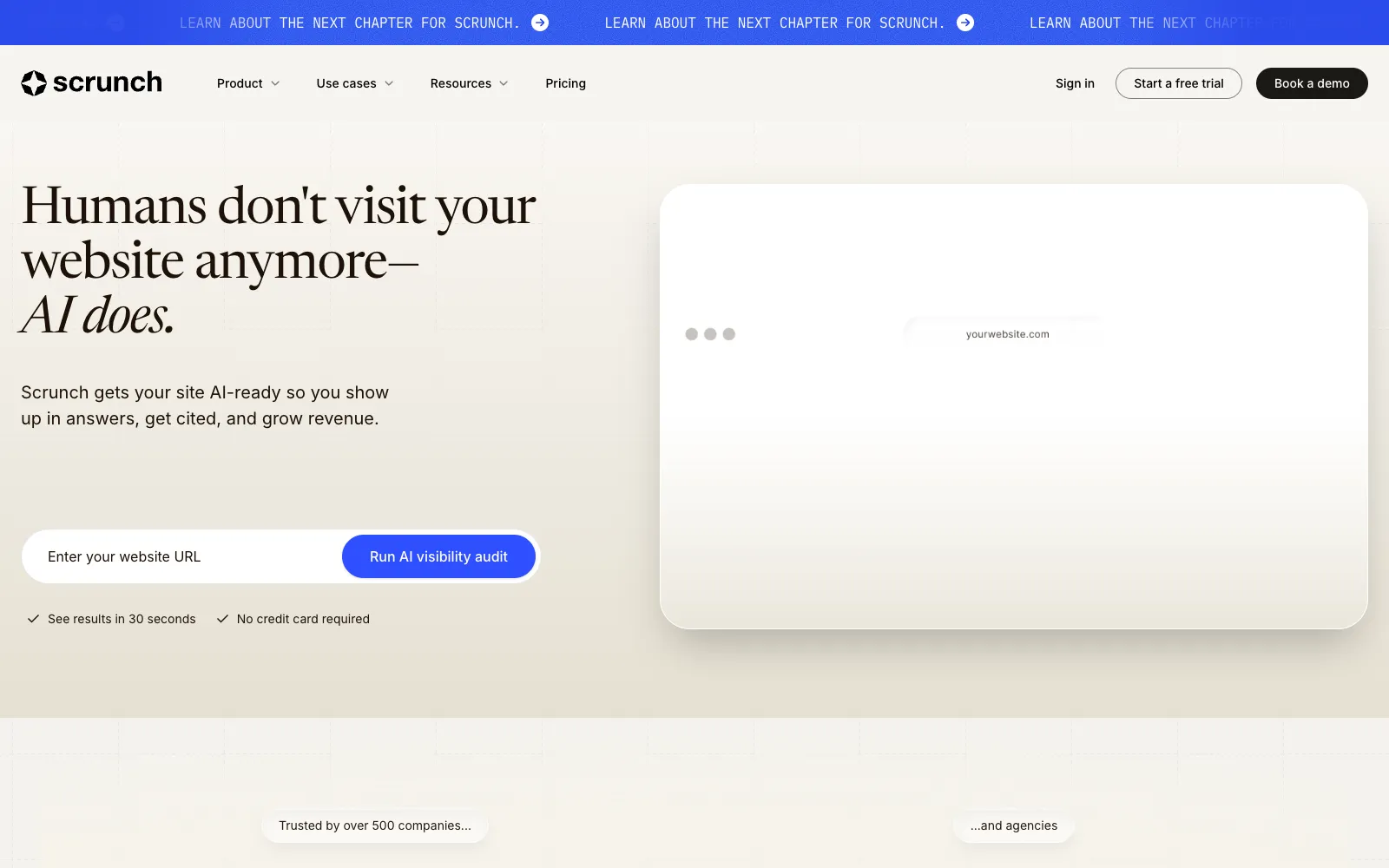
AI customer-experience platform for monitoring and improving brand visibility in AI search (ChatGPT, Claude, Perplexity, Gemini, Copilot and others), aimed at mid-market and enterprise brands and agencies.
Pros
- Broad AI engine coverage on standard plans (ChatGPT, Claude, Perplexity, Gemini, Google AI Overviews, Google AI Mode, Meta AI)
- Agent Experience Platform (AXP) serves compressed, machine-readable pages to AI retrieval bots at the CDN layer (Akamai, Cloudflare, Vercel) — the closest analogue to Klove's edge-served agent pages
- Clean, intuitive dashboard with filtering by topic, persona and custom tags; quick onboarding
- Crawler analytics with real-time bot tracking and GA4 traffic attribution
- Persona-based prompt tracking for audience-specific visibility
- Self-serve 7-day free trial with no credit card; SOC 2 Type II for enterprise
Cons
- Primarily a monitoring tool: Insights optimisation guidance is described by reviewers as beta-quality and light on actionable next steps
- No content generation or editing tools; page audits are manual and capped per tier (5-10), which does not scale for large sites
- AXP, its most distinctive capability, was reported by a 2026 reviewer as still in limited testing
- Prompt data reported to refresh weekly rather than daily
- Reviewers cite limited report generation, weak trend visualisations and occasional citation-data display errors
- Premium entry price ($250-$300/month) for what is largely monitoring
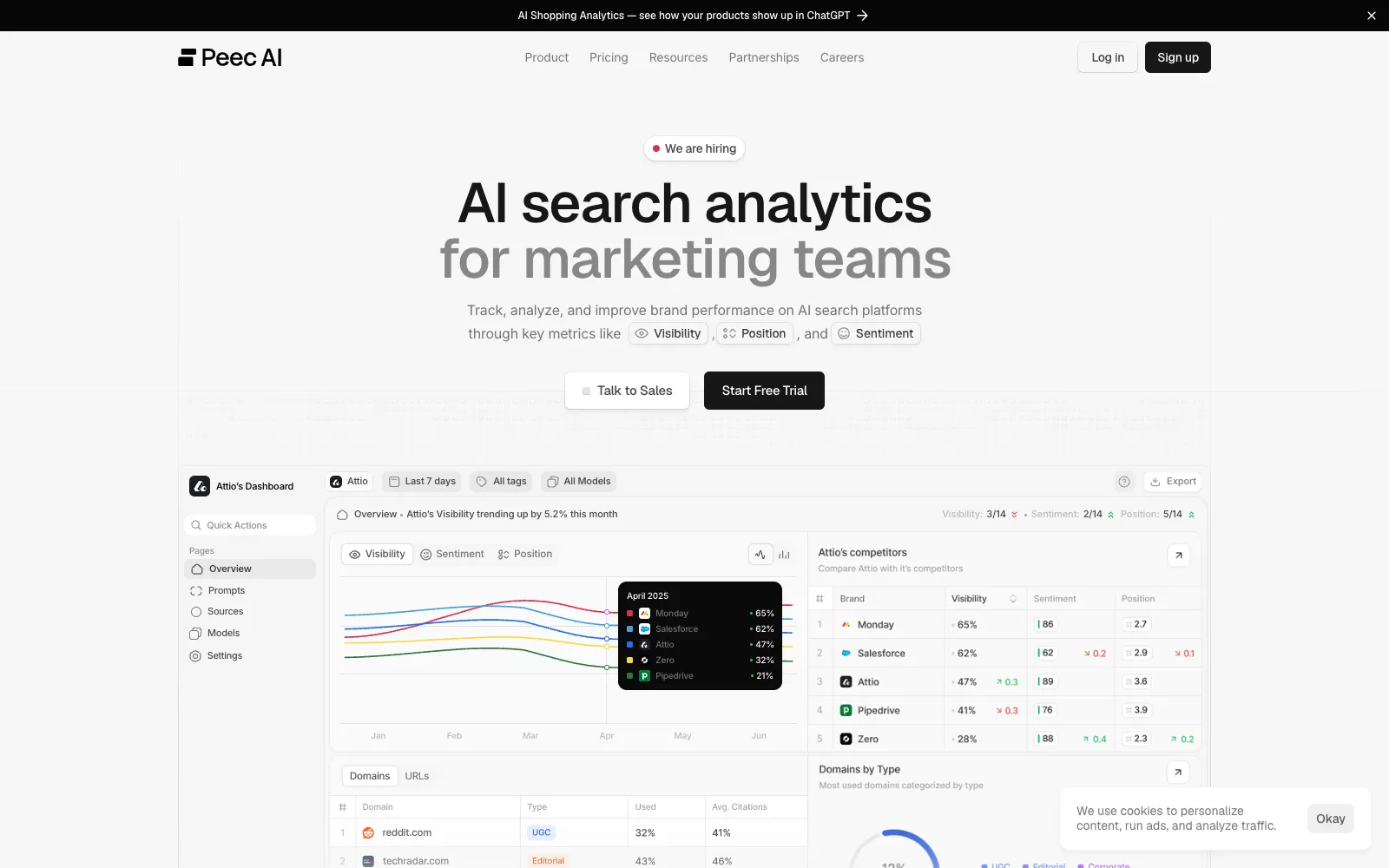
Berlin-based AI search analytics platform for marketing teams and SEO agencies, tracking brand visibility across ChatGPT, Perplexity, Gemini, Copilot and Google AI surfaces.
Pros
- Clean, focused interface with fast setup; well regarded UX
- Unlimited user seats on every paid tier
- Sentiment scoring and URL-level source analysis bundled, not sold as add-ons
- Multilingual and multi-country tracking without surcharge
- Crawl Insights: AI bot traffic analytics from server logs (Cloudflare, Vercel, WordPress, CSV upload) plus robots.txt audit
- Direct Slack access to the founding team, praised across reviews
Cons
- Monitoring only: no content optimization playbooks, site audits or step-by-step recommendations
- Does not serve or adapt pages for AI agents; analytics stops at reporting
- Self-serve plans limited to 3 engines; extra engines cost up to $165/model/month
- Claude tracking, API access and SSO gated behind Enterprise sales conversations
- No retroactive/historical data backfill
- Prompt allowances are modest at each tier relative to price
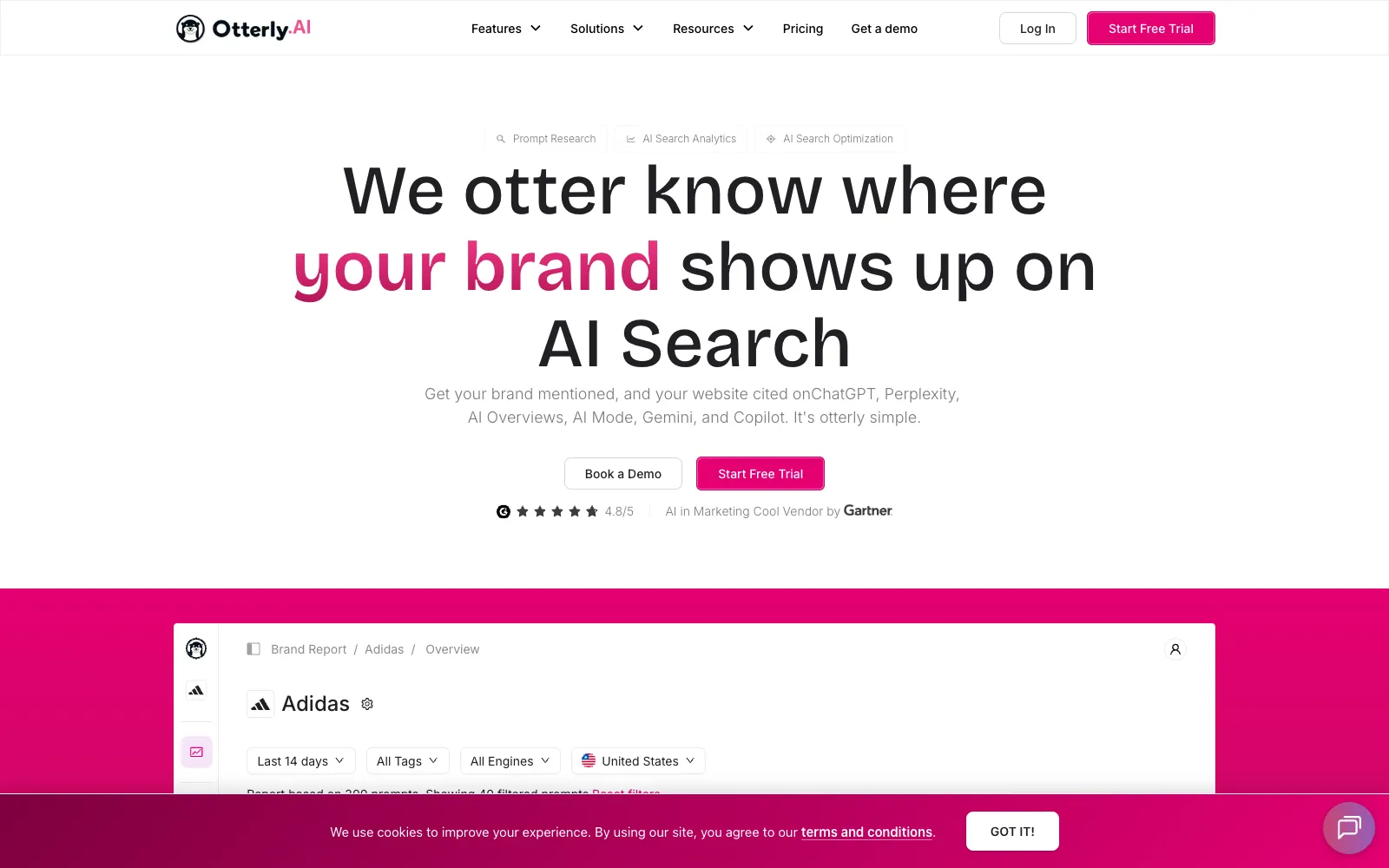
Self-serve AI search monitoring platform for marketing teams and agencies tracking brand mentions, citations and links across ChatGPT, Google AI Overviews, Perplexity and Copilot.
Pros
- Low-friction entry at $29/mo with transparent self-serve pricing and 7-day trial
- Agency-friendly: unlimited workspaces, Looker Studio connector, multi-country tracking
- Daily tracking with citation/link analysis, Share of AI Voice and sentiment
- Public API and MCP on Standard tier and above
- Highly rated on G2 (4.8/5) for ease of use and setup
Cons
- Tight prompt caps (15 on Lite, 100 on Standard); extra 100 prompts cost $99/mo
- Gemini, Google AI Mode and Claude coverage sold as paid add-ons, not included in base plans
- AI crawler analytics ('Agent Analytics') still in closed beta; no crawler log analysis
- Monitoring and recommendations only — does not change or serve anything on your site
- Reviewers note insights do not always translate into clear next actions
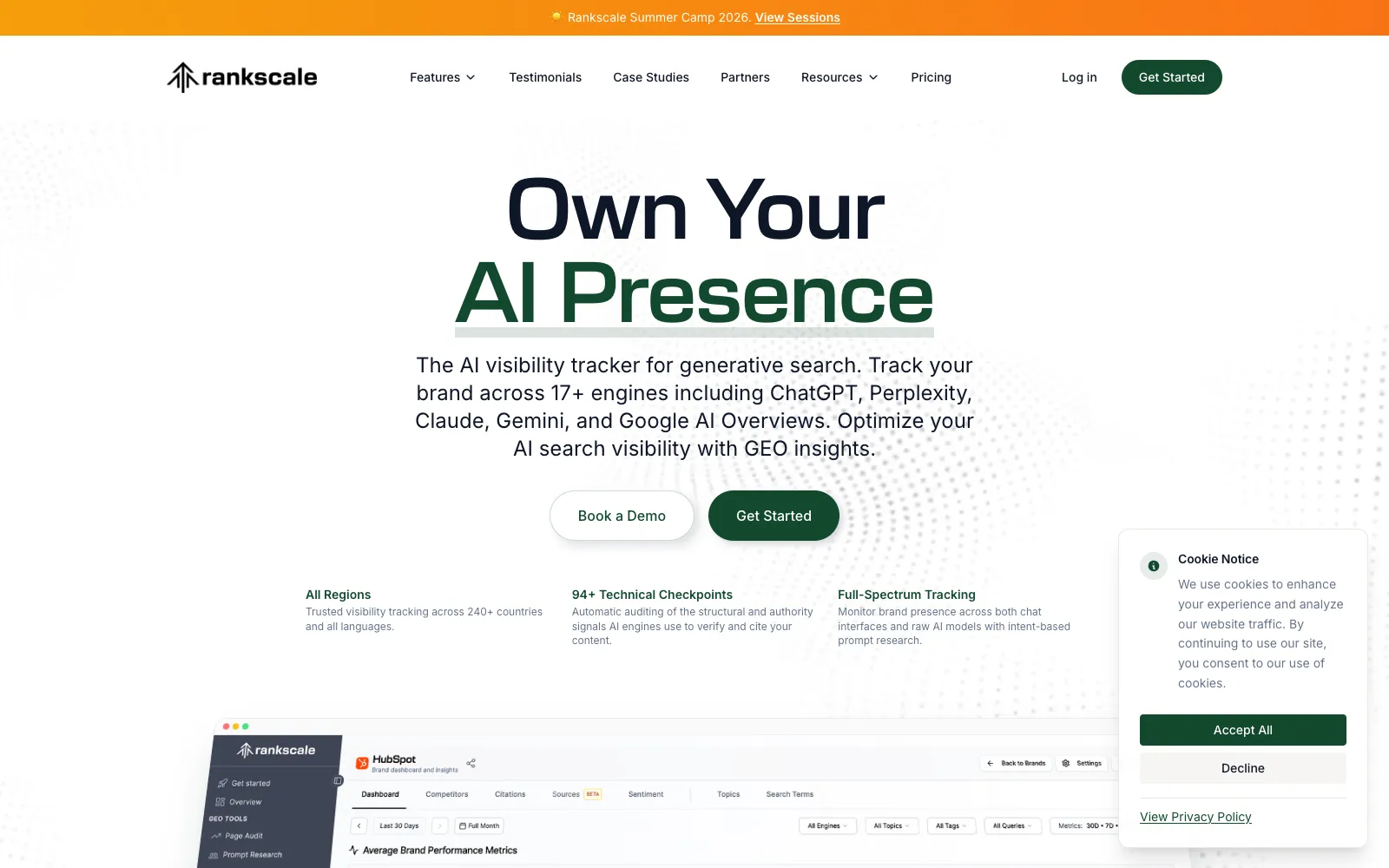
Credit-based AI visibility and citation tracking suite (GEO) for SEO professionals and agencies monitoring brands across 17+ AI engines.
Pros
- Broad engine coverage: 17+ AI platforms (ChatGPT, Perplexity, Gemini, Google AI Overviews/AI Mode, Claude, DeepSeek, Grok, Mistral) included on every plan, from $20/month
- AI-readiness site audits covering 94+ technical checkpoints (crawlability, hierarchy, structural signals)
- Competitor auto-identification with visibility, citation and sentiment comparison
- Founder-led product with frequent feature releases and responsive support
Cons
- Monitoring only: no way to act on findings within the product — no serving of optimised pages to AI agents or crawlers
- Does not track real AI crawler visits to your site; visibility is inferred entirely from simulated LLM prompts
- Credit-based metering makes costs hard to predict; scaling prompts, engines or run frequency burns credits quickly
- Technical learning curve; data visualisations under-explained and no PDF report export
- API access only from the $385/month Growth tier
- Thin presence on major review platforms (one G2 review, none on Trustpilot)
Which Profound alternative is right for you
There is no single winner: the right pick depends on whether you need to measure, act, or both, and at what budget. Klove or Scrunch AI if you want agent-facing pages served at the edge; Peec, Otterly or Rankscale if reporting is enough; and staying put is defensible if Prompt Volumes is central to your workflow.
- You want to act on AI visibility, not just measure it: Klove — Serves curated, machine-readable agentic pages to AI crawlers from the $69/month entry tier, with a transparent side-by-side editor and per-platform A/B testing.
- Enterprise teams wanting broad monitoring out of the box: Scrunch AI — Wide multi-engine coverage on standard plans, SOC 2, GA4 attribution and an agent-page layer (AXP) — at a $250+/month entry price.
- Agencies reporting on many clients, on a budget: Otterly.AI — Unlimited workspaces, Looker Studio connector and daily tracking from $29/month — the lowest-friction agency setup here.
- Widest engine coverage for the least money: Rankscale — 17+ AI engines on every plan from $20/month, though credit-based metering makes costs harder to predict at scale.
- European teams wanting daily tracking and clean UX: Peec AI — Daily tracking, unlimited seats, sentiment and multi-country coverage from $95/month, with EU pricing and a well-regarded interface.
One honest addendum: if what you specifically valued in Profound was its Prompt Volumes dataset — research into what people actually ask AI systems — none of these alternatives replicates that. It's Profound's most distinctive asset, and if it's central to your workflow, staying put (or running Profound alongside a cheaper acting layer) is a defensible choice.
Frequently asked questions
Is there a cheaper alternative to Profound?
Yes — several. Profound's Starter is $99/month but tracks ChatGPT only, and multi-engine tracking effectively starts at $399/month on Growth. Rankscale starts at $20/month with 17+ engines included, Otterly.AI at $29/month across four engines, Klove at $69/month (with a free AI traffic analytics tier), and Peec AI at $95/month.
What is the best Profound alternative for agencies?
Profound has no multi-account management on self-serve plans, so agencies usually need a custom Enterprise contract. Otterly.AI offers unlimited workspaces from $29/month, Rankscale offers multi-brand dashboards and white-label reporting, and Peec AI has dedicated agency plans. Klove suits agencies that want to manage agent-facing pages — not just reports — across client sites, with unlimited users on every tier.
Do any Profound alternatives actually change what AI agents see on my site?
Two on this list do. Klove serves curated, machine-readable agentic pages to AI crawlers at the edge from its $69/month entry tier, with a side-by-side editor showing exactly what agents receive. Scrunch AI's Agent Experience Platform does something comparable at the CDN layer, though it starts at $250+/month and a 2026 reviewer reported it was still in limited testing.
Profound itself is monitoring and reporting only.
Does Profound offer a free trial?
Only a 7-day trial on the Growth plan ($399/month, billed yearly); the Starter tier has no trial. Some reviewers on Capterra and Trustpilot reported unexpected post-trial charges and cancellation friction. By contrast, Klove has a permanently free AI traffic analytics tier, and Peec, Otterly and Scrunch all offer 7-day trials without a credit card.
Is Klove better than Profound?
They do different jobs. Profound is deeper as a pure monitoring and research tool — broader engine coverage, competitor benchmarking and its Prompt Volumes dataset — while Klove is the better fit if you want to act on the problem, serving optimised pages to AI agents from $69/month.
Profound has an established review base (4.6/5 from 845 G2 reviews); Klove is a newer product without published case studies yet.
See what AI agents see on your site — free.
Klove's AI traffic analytics tier is free and tracks 200+ AI agent signatures. Measure the problem before you pay anyone to fix it.

Prior to founding Klove, Michael spent over a decade at the intersection of engineering, growth marketing, and revenue operations - building GTM systems for high-growth B2B SaaS companies.